Showing posts with label herbal medicine. Show all posts

Tuesday, February 15, 2011

Essential Oils could help stop the spread of the deadly MRSA bacteria


Many moons ago I had this valuable information on my web site, but it has since been streamlined, and now I am archiving it here on the blog ..


Research findings from The University of Manchester:Essential Oils could help stop the spread of the deadly MRSA bacteria

21 Dec, 2004 - According to research carried out at The University of Manchester, essential oils have been found to kill the deadly MRSA bacteria.

Researchers tested 40 essential oils against ten of the most deadly bacteria and fungi. Three essential oils (which have not been disclosed) used in the tests killed MRSA and E. coli as well as many other bacteria and fungi within just two minutes of contact. Two of these oils killed MRSA and E. coli almost instantly, while a third was shown to act over a longer period of time, meaning that any soaps or shampoos made with a blend of these three oils would be effective over a period of time.

As aromatherapists and natural toiletry makers well know, the oils can easily be blended and made into items such as soaps, shampoos, lotions, etc ... which could be used by hospital staff, doctors and patients alike in an effort to eradicate the spread of these deadly `super bugs', which are becoming increasingly resistant to conventional means.

Jacqui Stringer who is Clinical Lead of Complementary Therapies at the Christie Hospital instigated the research. Jacqui works with leukemia patients at the Christie Hospital using essential oils to help in their treatment. Patients receiving treatment for cancer and leukemia are often left with weakened immune systems which makes them vulnerable to infection from MRSA. 'The reason essential oils are so effective is because they are made up of a complex mixture of chemical compounds which the MRSA and other super bug bacteria finds difficult to resist. The problem with current treatments is that they are made of single compounds which MRSA relatively quickly becomes resistant to, so treatment is only successful in around 50% of cases.'

'While a wide range of products currently exist to help prevent the spread of MRSA these are often unpleasant for patients as their application can cause skin irritation. MRSA is often carried inside the nose which means that patients often have to insert treatments up their nostrils, whereas these essential oils can simply be inhaled to prevent the patient being at risk,' added Jacqui.

Researchers are now desperately looking for funding to develop their work and carry out a clinical trial. Peter Warn from the University's Faculty of Medicine who worked on the research said: 'We believe that our discovery could revolutionise the fight to combat MRSA and other `super bugs', but we need to carry out a trial and to do that we need a small amount of funding ' around £30,000.

'We are having problems finding this funding because essential oils cannot be patented as they are naturally occurring, so few drug companies are interested in our work as they do not see it as commercially viable. Obviously, we find this very frustrating as we believe our findings could help to stamp out MRSA and save lives,' added Peter, who is based at Hope Hospital.

Note: This story has been adapted from a news release issued by The University of Manchester for journalists and other members of the public. If you wish to see the news releases see The University of Manchester as the original source.

Sunday, February 13, 2011

Oregano Oil may protect against drug resistant bacteria

The below press release is certainly not new news, but it is also not widely known information, so I'm spreading the word about that wonderful big bad bug fighter .. carvacrol type oregano essential oil. One of my personal EO staples!


Georgetown University Medical Center: Oregano Oil may protect against drug resistant bacteria

October 6, 2001 Press Release: Washington, D.C. — Oil from the common herb oregano may be an effective treatment against dangerous, and sometimes drug resistant bacteria, a Georgetown researcher has found. Two studies have shown that oregano oil — and, in particular, carvacrol, one of oregano's chemical components — appear to reduce infection as effectively as traditional antibiotics. These findings will be presented at the American College of Nutrition's annual meeting October 6 and 7 in Orlando, Fla.

Harry G. Preuss, MD, MACN, CNS, professor of physiology and biophysics, and his research team, tested oregano oil on staphylococcus bacteria— which is responsible for a variety of severe infections and is becoming increasingly resistant to many antibiotics. They combined oregano oil with the bacteria in a test tube, and compared oregano oil's effects to those of standard antibiotics streptomycin, penicillin and vacnomycin. The oregano oil at relatively low doses was found to inhibit the growth of staphylococcus bacteria in the test tubes as effectively as the standard antibiotics did.

Another aspect of the study examined the efficacy of oregano oil and carvacrol, which is believed to be the major antibacterial component of oregano, in 18 mice infected with the staph bacteria.

Six of the mice received oregano oil for 30 days, and 50% of this group survived the 30-day treatment. Six received the carvacrol in olive oil, not oregano oil, and none survived longer than 21 days. Six mice received olive oil alone with no active agents (the control group) and all died within three days. A repeat study corroborated these findings, which demonstrates that there are components of oregano oil other than carvacrol that have antibiotic properties.

"While this investigation was performed only in test tubes and on a small number of mice, the preliminary results are promising and warrant further study," Preuss said. "The ability of oils from various spices to kill infectious organisms has been recognized since antiquity. Natural oils may turn out to be valuable adjuvants or even replacements for many anti-germicidals under a variety of conditions."

Georgetown University Medical Center includes the nationally ranked School of Medicine, School of Nursing and Health Studies, and a biomedical research enterprise. For more information, please visit http://www.georgetown.edu/gumc.

4000 Reservoir Road NW Building D Suite 120 Washington DC 20007 202 687-5100 telephone 202 687-5213 facsimile http://www.georgetown.edu/gumc

Saturday, November 15, 2008

Jewelweed .. not bleach


I know that for folks reading this in many parts of the US, poison ivy (Toxicodendron radicans) isn't something they are necessarily thinking about, as the leaves have fallen and the gardening work has trickled to a minimum. But in my part of the country (gulf coast Texas), the growing season is still going strong, so its on my mind. Also, don't let Autumn and Winter lull you into a sense of security when it comes to poison ivy. The presence of urushiol (a chemical irritant present in the sap) is not limited to fresh ivy leaves. It is found in the dried leaves, and throughout the plant, even during the dormant season. It also sticks to clothes and pet fut, so a romp in the woods, or late season clean ups of the yard can end with a rash.

Jewelweed (Impatiens capensisis) is Mama Nature's soothing answer to Poison Ivy's vicious wrath. Chlorine bleach is NOT! I bring this up because apparently the "home remedy" of dousing one's already ivy irritated skin with a toxic chemical and known dermal irritant is very common, and not just limited to experimentation by total dumbasses either. Even one of the smartest cookies I know was masochistic enough to do that to his poor skin (names have been removed to protect the goofy ;). Words to the wise .. never put salt in your eyes (or was it always put salt in your eyes? ;) and never put chlorine bleach on your skin, especially irritated and/or broken skin {grinz}. (Yeah, I'm going to give him a bit of grief here and there about that one for the rest of this lifetime - tee hee)

Easy Wildflowers sells jewelweed transplants in springtime to grow in the garden.

The Wildman Steve Brill has a great site for information on wild foraging for jewelweed (and other plants).

Herbs Etc of New Mexico carries a great spray called Ivy Releaf. Do a Google search to find other resources for already made jewelweed soaps, salves and sprays.

It is really something worth having in the home if there is any chance of exposure to poison ivy, any time of the year.

Wednesday, November 5, 2008

Echinacea and Goldenseal Tinctures


'Tis the season to make medicinal tinctures. Today I started fresh batches of Echinacea (E. angustifolia) root and Goldenseal (Hydrastis canadensis) root tinctures. They will be ready in several weeks.

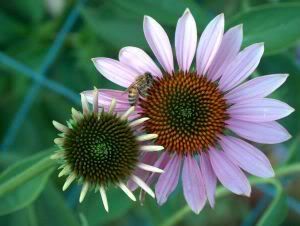
Long known to herbalists, Echinacea has in modern times been shown in scientific studies to boost immunity, help the body fight colds, infection, and many other things that may ail ye. It is a staple in my home.
http://www.nytimes.com/2007/07/24/health/24echi.html
http://www.herbs.org/greenpapers/echinacea.html


I find it very comforting to be able to simply grow this lovely plant species (that makes for great cut flowers too) in my garden, powder the root, and steep it in Everclear (grain alcohol) to produce a powerful medicine with a long shelf life for myself and my family.

Next blog - Goldenseal.